Expectancy
"Do I believe I can do this?"
Low expectancy collapses motivation in a way that feels like not caring. Indifference protects you from investing effort in something you expect to lose.
A practical field guide
Not the things you never wanted to do. The chapter. The application. The phone call. You intend to start, you feel something unpleasant, and you go and do something easier instead.
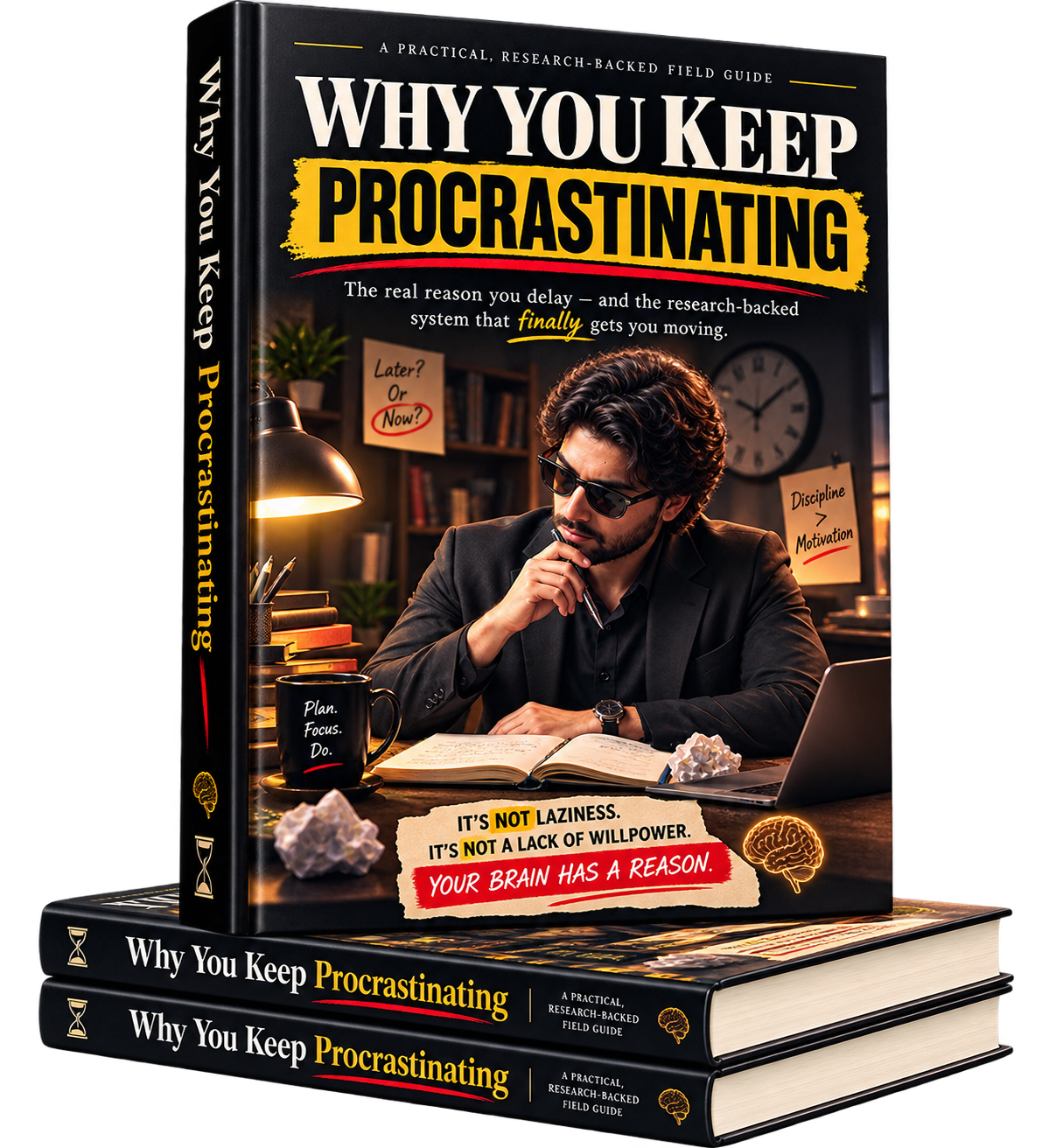
This is a short book with a narrow job: to explain what is actually happening in that moment — and to hand you tools that work on the real cause instead of the imaginary one.
It was never about willpower
₹99One-time · instant PDF download
Understand your pattern. Use the right tools. Start the 14-Day Reset.
The pattern
A lazy person does not want to expend effort. But on the day the deadline lands, you will work eleven hours straight and skip meals. That is not a person who lacks the capacity for effort. It is a person who could not access it until the fear got large enough.
By 4 p.m. the important thing has become radioactive — because looking at it means confronting the fact that you had eight hours and used none of them.
The reframe
If someone offered you a large amount of money to finish that task in the next hour, you would find the time. You already know how to plan. So the missing thing is not a planner.
What you have is an emotion problem wearing a productivity costume. The task makes you feel something unpleasant. Delay makes that feeling go away right now — instantly, reliably, free. Your brain, a very good learning machine, notices that avoidance works. Within seconds.
Which means, in the moment, you are not choosing between working and resting. You are choosing between feeling bad now and feeling bad later. And your brain has a strong, structural, well-documented preference for later.
Name the feeling underneath
Each one points to a different fix. Chapter 2 maps every feeling to the chapter that treats it — which is why "just get started" works for one profile and makes things worse for another.
"Procrastination is not a scheduling failure. It is a mood repair strategy that costs more than it pays."
You don't necessarily need more willpower. You need to understand what happens in the moment before you avoid.
The framework
One framework organises nearly everything else in the book. It comes from Piers Steel and Cornelius König's work on temporal motivation theory: how motivated you are right now depends on four things — which means there are exactly four levers.
Everything on top increases motivation · Everything below destroys it
"Do I believe I can do this?"
Low expectancy collapses motivation in a way that feels like not caring. Indifference protects you from investing effort in something you expect to lose.
"Does this feel worth doing?"
Both the reward and how tolerable the process is. Boredom is a value problem, not a discipline problem — so focusing harder fights the equation.
"How easily do I get pulled away?"
Really a ratio: the friction of starting versus the friction of the nearest escape. You can't easily change the trait. You can absolutely change the ratio.
"How far away is the payoff?"
The term that explains the 11 p.m. surge. Nothing about the task changed — the delay shrank to nearly zero and motivation spiked.
The book doesn't ask you to try another productivity hack at random. It helps you identify which lever is actually working against you — then hands you the two or three tools that pull it.
Part II · Your profile
From the outside, all procrastination looks the same: a person not doing a thing. Inside, it is six quite different machines — and treating the wrong one is worse than doing nothing, because failed advice teaches you that you are beyond help.
01
"It is not ready yet."
You are not avoiding work, you are avoiding evidence. While the document is unwritten it could still be brilliant. The broken term is expectancy.
02
"I'll deal with it when I have a clear head."
The task is not a task, it is a category. Your brain finds no executable action and quietly files it under later. You are not resistant — you are unbriefed.
03
"There is too much and I don't know where to start."
You know the steps; there are just too many to hold at once. Overwhelm is partly a storage problem, and the panic is accurate feedback.
04
"I work better under pressure anyway."
Delay as a defence against having your ability judged — what psychologists call self-handicapping. Elegant, because it works. You just never find out.
05
"Do not tell me what to do — including me."
Motivation exquisitely sensitive to autonomy. The cruel version: by Wednesday your own Sunday schedule has become an authority to rebel against.
06
"I'll get to it. Probably."
No fear, no freeze — the task is simply boring and attention goes where the stimulation is. Six hours on what interests you, six minutes on what doesn't.
Chapter 6 · The self-test
Score each statement 1–5, add the six groups, and you get your dominant and secondary drivers — plus the exact chapters that treat them. Take it before you read the profiles; read them first and you'll recognise yourself in all six, which is how horoscopes work.
₹99 · Instant download after payment · Read on phone, tablet or desktop
Inside the field guide
Fifteen chapters and three appendices across 56 pages — deliberately short, because a long book about procrastination is a superb way to procrastinate.
01 · Part I
What procrastination actually is, why it was never a time problem, the equation behind it, why your brain cannot see next Tuesday, and how shame makes it chronic.
02 · Part II
The 18-question test, the six profiles with the one move each needs — and an honest chapter on when avoidance is a symptom rather than a habit.
03 · Part III
Four levers, a feeling-first repair kit for the ninety seconds before you escape, and a minimal set of systems that do the remembering for you.
04 · Part IV
One task, fourteen small daily actions, then a chapter on relapse and the long game — plus the cheat sheet and reusable worksheets.
Part III · The toolkit
The toolkit is deliberately larger than you need, because different profiles need different pieces. The instruction in the book is explicit: pick two or three that match your profile. Not twenty.
Believe you can do it
Make it worth doing
Beat the impulse
Shrink the distance
Fixing the feeling first
So you don't have to remember the tools
Chapter 14 · The plan
Week one — diagnose and start
Day 1 · 10 min
Write the task, then the feeling it triggers. No work on the task today.
Day 2 · 10 min
Rate all four terms 1–10. Circle the two you will actually work on.
Day 3 · 15 min
Take the 18-question test. Read only your highest profile and do its one move.
Day 4 · 15 min
Break it down until no step needs a decision. Write the first one on a card.
Day 5 · 10 min
One implementation intention with time and place, plus one for the obstacle.
Day 6 · 15 min
Execute the if-then. When the timer goes off you may genuinely stop.
Day 7 · 10 min
Neutral language only, and one line of evidence. No verdicts.
Week two — build the machine
Day 8 · 25 min
One change that blocks your escape, one that makes starting easier. Physically.
Day 9 · 20 min
Within seven days, with a witness or a cost. Tell someone today.
Day 10 · 20 min
Bundle a reward, add a score, or choose your own conditions.
Day 11 · 20 min
Catch one urge to escape. Three questions, stay seated ninety seconds.
Day 12 · 25 min
In person, on a call, or in public. For many people this is the single most effective change.
Day 13 · 15 min
Three items, frog first, first action, time and place. Tonight and every night.
Day 14 · 30 min
What worked, what you skipped, which two tools you keep — and the next task you point them at.
What success looks like, according to the book: not fourteen perfect days. If you did something on eight or nine of them, the fortnight worked.
Appendices A & B
A one-page cheat sheet — the whole book compressed — and five reusable worksheets designed to be copied out by hand and used for the rest of your working life.
Worksheet 1
Task, what you did instead, the feeling underneath. After ten entries the pattern is obvious.
Worksheet 2
Score all four terms, find your broken one, write the next physical action and a payoff within days.
Worksheet 3
The plan, the defence for the predictable obstacle, and the witness you report back to.
Worksheet 4
Ninety seconds a night: tomorrow's frog, the first physical action, the time and place you start.
Worksheet 5
Five questions — including the one that makes this a procrastination system rather than a productivity one.
Appendix A
The diagnosis, the equation, the six profiles, the five highest-return moves and the two rules — on one page.
Take a look inside
Four short passages from the 56 pages — the central claim, the diagnostic exercise, the cheat-sheet table and one of the worksheets.
"Their argument, roughly: procrastination is a failure of emotion regulation, not time regulation. The delay is not the goal. Feeling better right now is the goal, and delay is simply the fastest available way to get there."
The evidence
Tice and Baumeister found procrastinating students reported less stress early in the semester — then more stress, more illness and worse grades by the end.
Take the task you have been avoiding and score each term from 1 to 10.
"Your lowest-scoring top term and your highest-scoring bottom term are your two problems. Fix those. Ignore the rest."
Copy this onto an index card every night. Ninety seconds.
Tomorrow's frog (do first, best hours):
First physical action:
Time and place I will start:
Two other things (optional):
Your purchase includes
56 pages. Four parts, fifteen chapters, three appendices. Delivered immediately after payment — yours to keep, readable on any device.
₹99One-time payment · no subscription
Get this eBookThe book is explicit about its own limits, so this page will be too.
Fair objections
This one starts with diagnosis. Generic advice pulls one lever at random: tell a perfectionist to just get started and starting badly confirms their fear; tell a bored person to break the task down and they now have twelve small boring tasks. The book asks which mechanism is driving your delay first.
That gap between intention and action is the entire subject. Part I explains what happens in the four seconds before you open a new tab; Chapter 12 is about the ninety seconds when it actually shows up.
The word does not fit the evidence. A lazy person does not want to expend effort; you will work eleven hours straight when the fear gets large enough. And procrastination is rarely inactive — you are cleaning a kitchen you have not cleaned in months. You are willing to work, just not on the thing carrying the bad feeling.
No, and the book refuses to claim it. What can change is the size of the gap between deciding and starting — days becoming hours — plus recognising the pattern in real time and recovering faster after a lapse.
No. Part I is read in order; then you identify your profile and use only the two or three tools that match it. If you have five minutes and no patience, the book tells you to start with the one-page cheat sheet, then read Chapter 2.
Questions
Why you delay things you actually intend to do, and what to do about it. Its argument is that procrastination is a problem of emotion regulation rather than time management, and that the fix depends on which mechanism is driving your delay.
Anyone whose delay is costing them something — work, study, admin, health, the projects that have no deadline at all. It assumes no prior reading in psychology.
56 pages: four parts, fifteen chapters and three appendices. Deliberately short — the book notes that reading about procrastination is itself a superb way to procrastinate.
What procrastination actually is; why avoidance is reinforced within seconds; the four terms of the Procrastination Equation; why the future feels like a stranger; how shame makes delay chronic; your own profile; and a matched set of tools plus a fourteen-day plan.
A fortnight of small daily actions — most 10 to 25 minutes — pointed at one task you have been avoiding. Week one diagnoses and starts; week two builds the environment, deadlines, pause and evening card into a routine.
Yes — eighteen statements scored 1 to 5, about four minutes, with a scoring table that maps your dominant and secondary profile to the exact chapters that treat them.
Five, in Appendix B: the Procrastination Log, Task Decoder, Implementation Intention Builder, Evening Card and Weekly Review — designed to be reused indefinitely. Appendix A is a one-page cheat sheet of the whole book.
Yes. It is a PDF, so it opens on phones, tablets, laptops and e-readers, and you can print the worksheets if you prefer to write by hand.
No. It is educational, not medical, and says so on its first page. Chronic, disabling avoidance can be a symptom of ADHD, depression, anxiety disorders or burnout; Chapter 7 exists to help you tell the difference and points you toward proper assessment rather than another planner.
You don't need to become a completely different person. You need to understand what happens in the moment before you avoid.
"Start before you feel ready. You will never feel ready, and it turns out you never needed to be."
A practical field guide
The real reason you delay — and the research-backed system that finally gets you moving.
₹99 · Instant PDF download · Read on any device · Then do fifteen minutes.
₹99 · Instant PDF download